

The Stone with the Longest Stripe
The Stone with the Longest Stripe
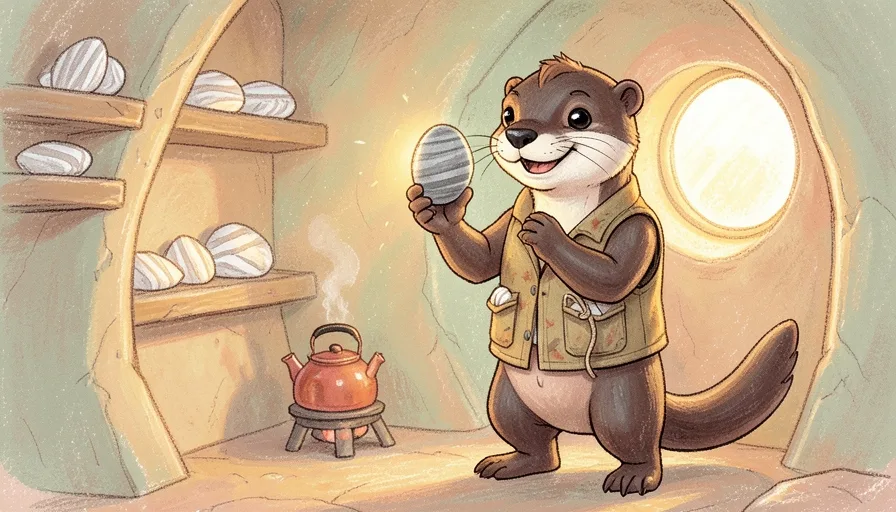
The river made a slow, lazy bend, and right where it curved, tucked beneath the roots of an old alder tree, sat a round green door. Behind it lived Tully, and behind it lived a very great many stones.
They stood on shelves along every wall, and there were more shelves than a burrow strictly needs. Each stone was smooth as a sleeping cat, and each one had a single white stripe running through it like a thread of cream through dark tea.
'This one,' said Tully, holding a grey pebble up to the window light, 'is Biscuit. I found her the morning of the great mist, when the river whispered instead of splashed. And this one is Admiral Pip, who was lying on the bottom looking terribly important.'
He set Biscuit back on her shelf with the gentleness of someone tucking in a baby. The burrow smelled of damp earth, warm pine shavings and the faint sweetness of the clover tea simmering on the stove. It was, Tully thought, the finest place in the whole wide world.
A shadow slid across the window, long and thin, and then came a tap-tap-tap at the glass like a patient raindrop. Tully knew that tap. He flung open the round green door.
'Orla!' he cried. 'You are just in time! I have found a new stone and it has the most remarkable stripe, wider than a ribbon, and I was going to tell you all about the day I found it, which was Tuesday, and the water was doing a thing it only does on Tuesdays...'
Orla ducked her long grey neck under the door frame and smiled. She was a heron, tall as a lamp post, with a faded green scarf wound twice about her neck and a voice as quiet as pages turning. She had been Tully's best friend since the spring he had accidentally splashed her and then spent an hour apologising.
'I would love to hear all about Tuesday,' she said. But she did not sit down on her favourite stool by the stove, and Tully, who noticed a great many small things about stones, noticed that too.
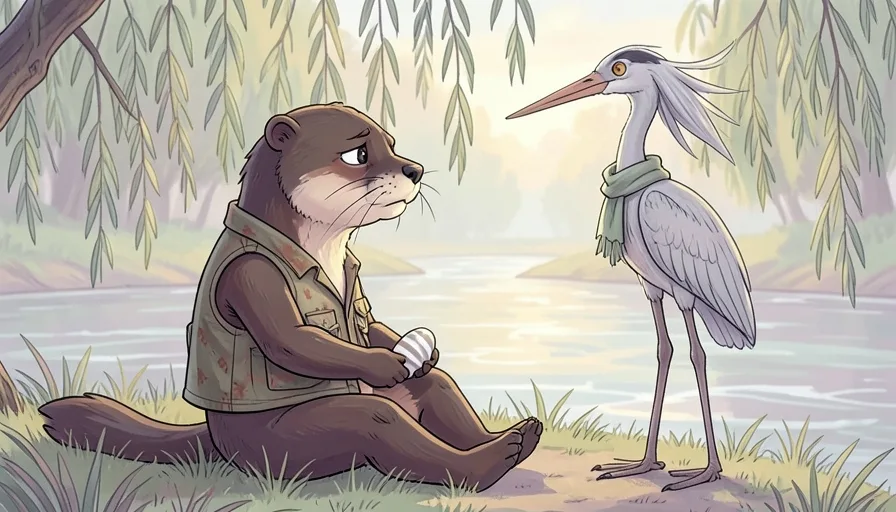
They sat on the low bank outside, where the river chuckled over the shallows and the willow leaves hung like green ribbons. Orla folded and unfolded the end of her scarf.
'Tully,' she said at last, 'I have something to tell you, and I have been trying to find a gentle way to say it all week.' She took a breath. 'I am moving away. The far marshes, where my aunt lives. Her legs are too old to fish alone now. I leave when the moon is full.'
The river kept chuckling as if nothing had happened, which seemed to Tully very rude of it. He looked down at the stone in his paw, and for once he could not think of its name.
'When the moon is full,' he repeated slowly. 'That is only three nights away.'
'Three nights,' Orla agreed softly. She looked at him with her wide, kind, golden eye. 'I am sorry, Tully. I did not want to go without saying goodbye properly.'
Tully's whiskers drooped, just a little, and the smell of clover tea drifted out through the open door and went on being cozy all by itself.
For a long moment neither of them spoke. A dragonfly hovered by the water, shimmering blue, and then zipped away.
Then Tully lifted his head, and something in his eyes began to sparkle the way it always did when an idea walked in. 'Orla,' he said, 'have you ever heard of Lantern Island?'
'The one the old otters tell stories about?' said Orla. 'The island that is not on any map?'
'That is the very one!' Tully leapt to his feet, stones clinking in his pockets like tiny bells. 'They say it floats at the far end of the willow fork, and that at night the stars hang so low over it you could pick one off the sky. I have wanted to sleep under those stars for as long as I can remember, but it never seemed right to go alone. A star is too big to enjoy by yourself.'
He turned to her, grinning from ear to ear. 'So we will go together! One last adventure, before the moon is full. We will sleep on the island, and we will watch the whole sky switch on, and you will never forget your old friend Tully.'
Orla blinked. Her scarf stopped fidgeting. 'Tully,' she said, 'you cannot know the way. No one knows the way.'
'Then,' said Tully happily, 'it will be a proper adventure.'
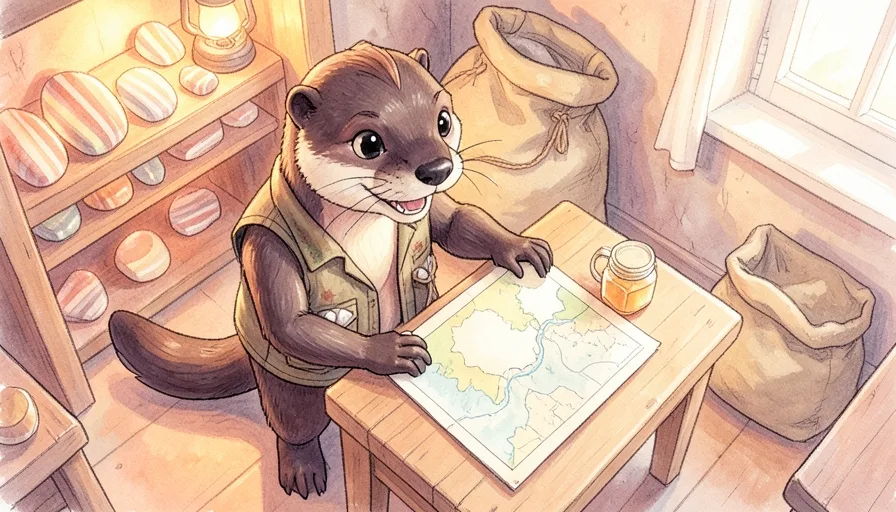
The next day was a flurry of the very best kind. Tully darted about the burrow with a patched canvas sack, packing with the care of an otter who takes his packing very seriously.
In went two jars of clover honey, a coil of rope, a tin cup, three wedges of seed cake wrapped in a dock leaf, and Orla's old river map, which was soft as cloth from folding. In the middle of the map, where the willow fork ought to lead somewhere, there was only a blank cream patch, as if the mapmaker had simply run out of courage.
'We shall fill it in ourselves,' said Tully, tapping the empty space with one claw.
Orla stood in the doorway and watched him, the corner of her beak curving up. She had planned to spend her last three days quietly, wrapping teacups in newspaper. But the burrow was loud with Tully's happy humming, and the loudness was somehow better than the quiet, and she found that her heart felt lighter than it had in a week.
'Very well,' she said at last. 'But I am bringing extra seed cake.'
'The most important supply of all,' said Tully solemnly.
By evening the sack was packed and propped beside the round green door, and Tully was standing in front of his tallest shelf, frowning thoughtfully. Every journey, he believed, needed a stone.
He ran his paw along the rows. 'Biscuit stays, she hates travelling. Admiral Pip stays, he is far too dignified.' Then he reached the very top shelf and lifted down a long, flat, silver-grey stone, heavier than it looked. Its white stripe ran from one end to the other without a single break, bright as a thread of moonlight.
'This,' said Tully, in the hushed voice he saved for truly great things, 'is the Longest Stripe. I found it the very first day I came to the river. It has never once been wrong about anything, mostly because I have never asked it anything. But I think it should come along.'
He slipped it carefully into his vest pocket, where it settled with a comfortable clunk against the others.
'Why that one?' asked Orla.
Tully thought about it. 'Because a stone with a stripe that long,' he said, 'must be going somewhere.'
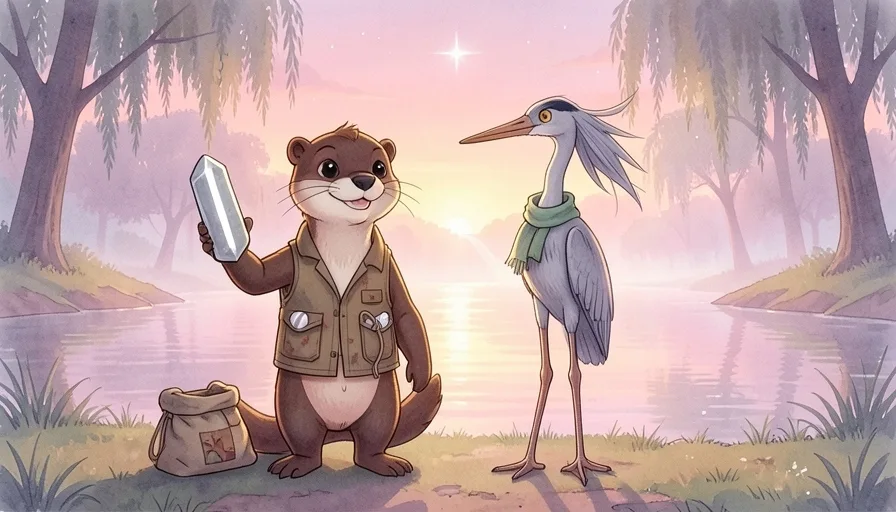
The sun melted down behind the willows and the whole river turned the colour of rose petals. Tully and Orla stood at the edge of the bend, side by side, looking toward the far fork where the water went misty and mysterious.
Frogs began to sing in the reeds. The air smelled of cool mud and wild mint, and somewhere above them the first pale star blinked awake, as if it already knew where they were going.
'At first light,' said Tully, patting the sack at his feet, 'we begin.'
'At first light,' Orla echoed. She tugged her green scarf snug against the evening breeze. 'Tully? Whatever we find out there, or do not find... thank you for asking me.'
Tully reached into his pocket and drew out the Longest Stripe, holding it up so that the last of the sunset caught the white line and set it glowing. 'You do not have to thank a person for the best idea he ever had,' he said, grinning. 'You just have to bring the seed cake.'
And far away, beyond the bend and the willows and the soft grey mist, an island that was on no map at all waited for the stars to come out.
"The best adventures are the ones we choose to share with the people we love."
The Fork in the Mist
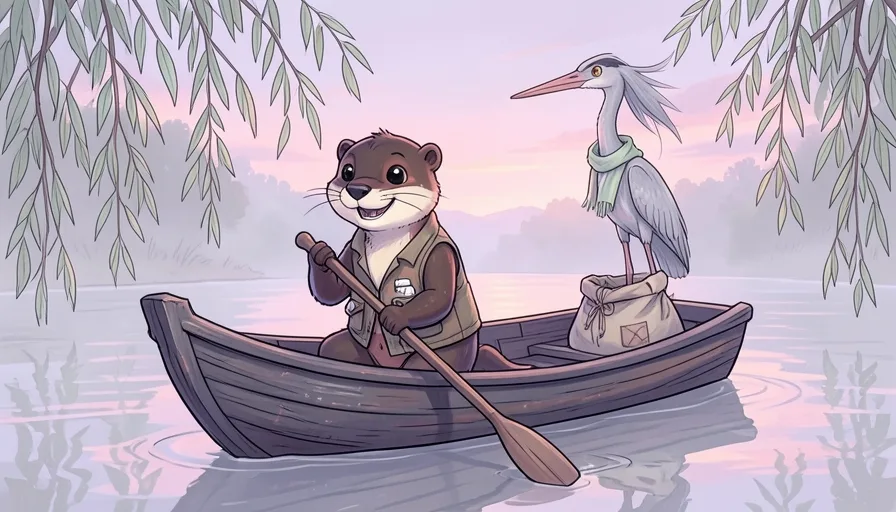
The first grey light had barely touched the willows when Tully was already knee-deep in the shallows, pushing a hollow log out from the bank. He had spent the whole of the previous afternoon hollowing it out with a clamshell, and he patted its smooth round side the way other people pat a horse.
'She is called the Plum,' he announced, 'because she is dark and round and will not sink.'
'You named her after a fruit,' said Orla, stepping in with great care, one long leg at a time. The log wobbled once, thought about it, and settled. She tucked the patched sack between her feet and drew her faded green scarf up against the chill.
Tully hopped in after her with a splash, took the short paddle, and pushed off from the bend. His round green door grew smaller behind them. For one tiny moment his whiskers trembled, because he had never left his burrow before anyone else was awake, and the whole river seemed to be holding its breath.
Then a kingfisher flashed over the water like a thrown blue pebble, and Tully laughed out loud. 'Look at that! Even the birds are in a hurry to see the island.'
'The birds,' said Orla dryly, 'are in a hurry to eat breakfast.' But the corner of her beak had curved up again.
The mist thickened as they drifted, until the world shrank to a soft white room with a river for a floor. Water dripped from the willow fronds, plip, plip, plip, and somewhere ahead a frog cleared its throat and thought better of singing.
'Right,' said Tully cheerfully, 'what is the plan?'
'You are the one who paddles,' said Orla. 'I am the one who reads the map.' She unfolded it across her knees and smoothed it flat. The river ran bravely down the paper, curled round the bend, split into two lines at the willow fork, and then simply stopped. After that there was nothing but that cream-coloured blank.
As if on cue, the log slid out of the mist and the river divided before them. To the left, a wide bright channel glittered, and to the right, a narrow green one tunnelled away beneath leaning willows, shadowy and quiet.
Tully's cheerful smile did not wobble even a little. 'Well, here is where it gets exciting.'
'Here,' said Orla, 'is where it gets difficult.'
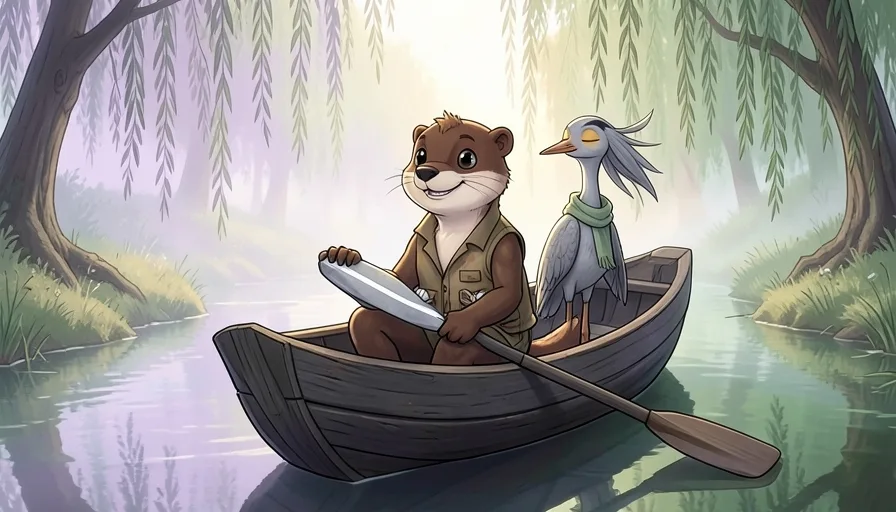
Tully shipped his paddle and drew the Longest Stripe from his vest pocket. He held it up in the grey light, and its white line shone like a ribbon of milk.
'It has never been wrong,' he said, 'mostly because I have never asked it anything. So I am asking now. Longest Stripe, which way?' He balanced it flat on his paw and tilted his paw to the left, then to the right, to see which way it leaned.
The stone sat perfectly still, as stones do.
Orla watched this with her head tipped to one side. 'Tully,' she said gently, 'a stone cannot choose. It will only go where you tilt it.'
'Then I will tilt it very honestly,' said Tully, and he squinted, and the log drifted on, and the mist drew closer around them.
Orla closed her golden eyes. 'Be quiet a moment,' she said. 'Listen.'
Tully, who had not been quiet since sunrise, tried it. The wide channel made a flat, whispery hush, like a crowd at the back of a hall. But from the narrow channel came a chattering, a tumbling, a busy little laugh of water over many stones.
'The right one is happy,' said Orla softly. 'Rivers laugh like that when they are going somewhere.'
Tully lowered the stone and looked at it, a little embarrassed. 'I suppose,' he said, 'I wanted something else to be brave for me.'
Orla opened her eyes. For a long time she said nothing, and the log turned slowly on the water, and the two channels slid past them like two doors.
'I will tell you a secret,' she said at last. 'I have not slept well all week. Every night I lie awake counting the things I will miss. Your tea. Your terrible humming. The way you introduce a stone as though it were royalty.' She smoothed the map against her knee. 'But last night, I dreamed of the stars on that island. And I woke up wanting to see it. Not only for you. Just for me.'
Tully's whiskers rose all the way up. 'You want to go?'
'I want to go,' said Orla, and her voice was steadier than he had ever heard it. 'So, I choose the laughing water. And if I am wrong, we shall simply paddle back and choose again.'
'That,' said Tully, tucking the Longest Stripe safely away, 'is the best plan I have ever heard.'
He dipped his paddle, and the Plum turned her round dark nose toward the narrow channel, and in they went.
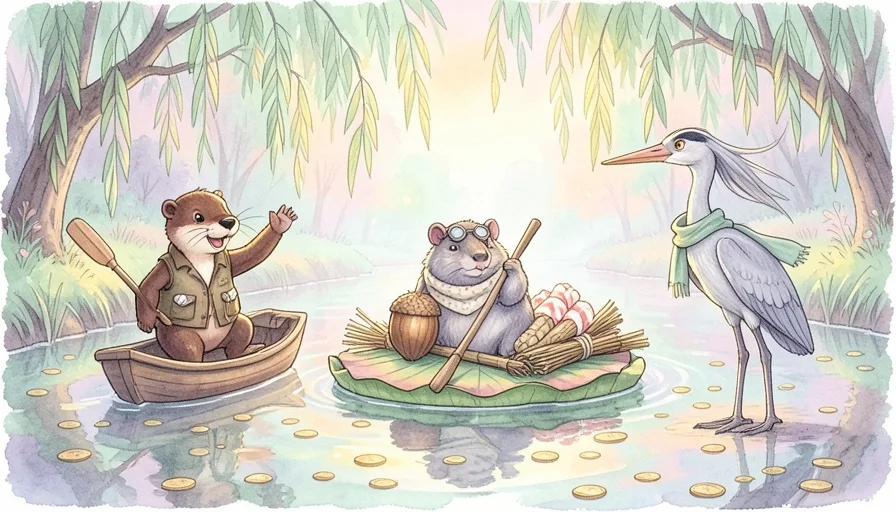
The willows closed overhead like the ribs of a green cathedral. Light came through the leaves in soft coins that rippled across the water and across Tully's whiskers. The air smelled of wet bark and wild mint, and everything sounded far away and wrapped in cotton.
'Do you hear that?' whispered Orla. 'Something is humming.'
It was a low, grumbling hum, rather like a kettle that had given up boiling. And then, around a drooping curtain of branches, a raft appeared: a great flat lily pad, wider than a table, piled high with bundles of peppermint leaves tied with reeds. On top, a short, plump, very old mole sat on an upturned acorn cup, steering with a pole as long as she was.
She looked at them without hurry. Her eyes were lidded and golden and had clearly seen everything twice.
'Mm,' she said. 'Visitors. Nobody uses this channel but me and the dragonflies.'
'Good morning!' Tully sang out, waving his paddle. 'I am Tully, and this is Orla, and we are looking for an island that is on no map at all. Have you perhaps seen it? It is called Lantern Island.'
The mole did not blink. 'Vesper,' she said. 'Peppermint ferrier.' She patted a bundle on her raft. 'Never heard of an island,' she said slowly. 'But I have seen lights, some nights, past the last of the willows.'
'Lights!' Tully breathed, and he nearly stood up in the log, which made it wobble so badly that Orla grabbed both sides and gave him a very long look.
Vesper chuckled, a deep, rumbly, burrowy sound. 'You are not the first to ask. And you will not be the last.' She tapped her pole against a bundle of mint, and the sweet green smell rose up around all three of them. 'But I do not give directions to strangers. Not free.'
'Oh, I have plenty to trade,' said Tully at once, and he began pulling stones from his pockets. 'This one is Pebble the Brave. This one is Marigold, found the day of the big thunderstorm. This one is Sir Reginald, who has a very fine stripe...'
'Tully,' said Orla.
He stopped, a stone in each paw. The Longest Stripe was in his pocket, warm against his ribs, and he suddenly understood that he did not want to part with it at all. He cleared his throat. 'Er. Which one would you like?'
Vesper only smiled her slow, wide smile. 'We shall see,' she said. 'Come alongside, little otter. Tie up your Plum. It is a long way yet, and I have never been in a hurry in my life.'
And the narrow green water chuckled on beneath them, as though it knew something they did not.
"Not knowing the way is only frightening until you have a friend to choose it with."
The Peppermint Tangle
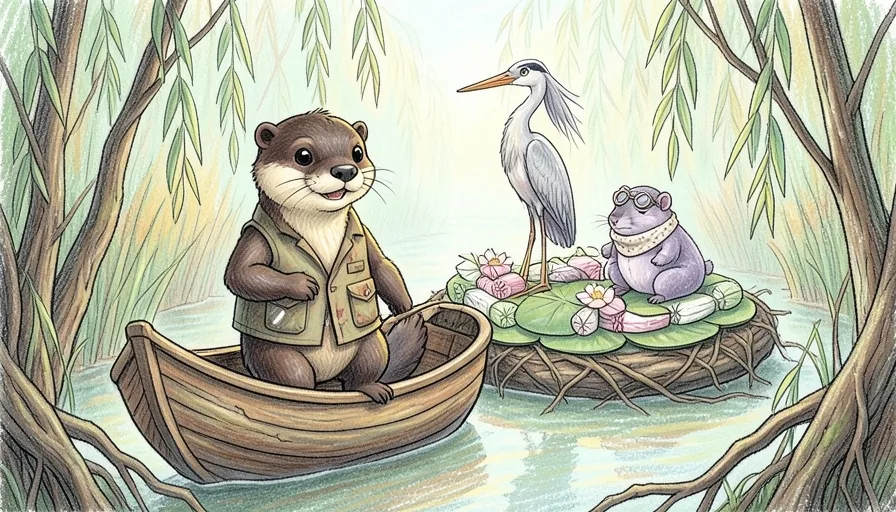
Tully eased the log alongside the great lily pad and looped his rope twice around a stout stalk of peppermint. Up close, the raft smelled so sweetly of mint that his whiskers tingled and his nose gave a small, delighted twitch.
'Now,' said Vesper, resting her long pole across her knees, 'about your trade.' She did not look at his pockets full of stones. She looked at the back of her own raft, where the lily pad had drifted into a snarl of old willow roots. They knotted over and under one another like a basket someone had dropped in the water.
'Ah,' said Orla softly, folding her map. 'You are stuck.'
'Stuck since sunrise,' Vesper agreed, with all the worry of a person remarking on the weather. 'The roots grab a pad every spring, and every spring I wait for someone to come along and be useful. You, little otter, look useful.'
Tully had never been called useful before, only talkative. He stood a little taller in his vest, and a stone slipped from his pocket and plopped into the water, which made him wince.
'Free my raft,' said Vesper, 'and I shall tell you something true about those lights. Not a rumour. A real thing, from my own two eyes.'
'Is there anything else?' Tully asked hopefully, patting a pocket. 'Because I have very fine stones.'
Vesper's slow smile did not change. 'I already have stones,' she said. 'I have never had enough patience in anyone else. Try that instead.'
They set to work. Orla, with her long legs, stepped out onto a mossy root and probed the tangle with her beak. Vesper pointed with her pole and gave directions in a slow, unbothered drawl. Tully, who had volunteered to do the pulling, took hold of the nearest root and heaved.
Nothing happened.
'Again,' said Vesper. 'Gently. A root is like a gossip. It tightens when you rush it.'
Tully pulled again, more gently, and the root gave a reluctant inch. He tugged the next one, and the next. Each time he wanted to hurry, to shout a cheerful 'Almost there!' and finish quickly, and each time he made himself breathe and wait. It was dreadfully hard. Waiting was not at all like collecting stones; stones could be picked up and counted and put on a shelf, while patience just sat there inside you like a held breath.
'You are doing it,' said Orla, without looking up from her probing. 'You are doing it very well, you know.'
Tully's ears warmed. 'I am merely standing here being slow,' he said.
'Yes,' said Orla. 'That is the hardest thing you have ever done, and I have known you eleven years.'
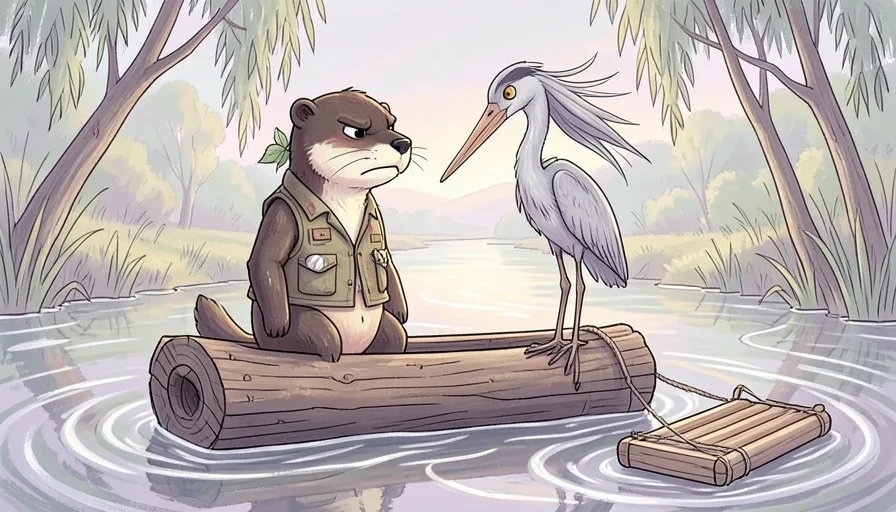
At last the final root loosened with a soft, wet pop, and the lily pad slid free so suddenly that Vesper rocked on her acorn cup and chuckled her deep froggy chuckle.
'Well,' she said. 'Mm. That was useful.'
Tully sat down hard in the log, damp to the elbows, a leaf stuck behind one ear, and found that he was grinning. His paws ached, and somehow he did not mind. The roots lay quiet behind them, and mint-scented ripples spread across the green water like slow rings of light.
Then Orla went very still on her root. Her golden eyes narrowed, and she turned her head to the water, listening.
'Tully,' she said. 'The river is going faster.'
'Faster than what?' he asked, wiping his paws on his vest.
'Faster than it was when we came in.' She stepped carefully back into the log. 'Rivers do not hurry without a reason. Something ahead is pulling on it. Or something behind is pushing.' She glanced up through the leaves, though no moon was there to see. 'It makes me think the days may be shorter than I counted.'
Tully looked at the water. It did seem to chatter a little more sharply, the laughing gone quick and breathless, like someone running to catch a train. He put one paw on the Longest Stripe in his pocket, just to feel it there.
Vesper, who had said nothing for a while, plucked a peppermint leaf from the nearest bundle and tucked it into her cheek like a sweet. She regarded Orla for a long moment with her lidded golden eyes.
'You hear that, heron,' she said. 'Good. Most do not listen to the water until it is too late to hear it.' She leaned her pole against her shoulder. 'I promised a clue. Here it is, and it is the only one I have.'
Tully leaned forward so far the log tipped, and Orla steadied it with one foot.
'There are lights past the last of the willows,' said Vesper slowly. 'I have seen them from the far end of my route, on still nights, glowing low on the water like a handful of tossed stars. Do not follow the lights themselves. They drift. Follow the stone that glows.'
'A stone that glows?' Tully breathed. He thought of the Longest Stripe, quiet and plain in his pocket, and then of all his shelves at home, every stone with its white stripe, and not one of them had ever lit up a single dark corner. 'What kind of stripe does it have?'
'That,' said Vesper, 'I have never been near enough to see. Only that it sits at the edge of the dark, and the lights lean toward it.' She chewed her mint thoughtfully. 'I would hurry, if I were you. But I am not you. I have never hurried in my life.'
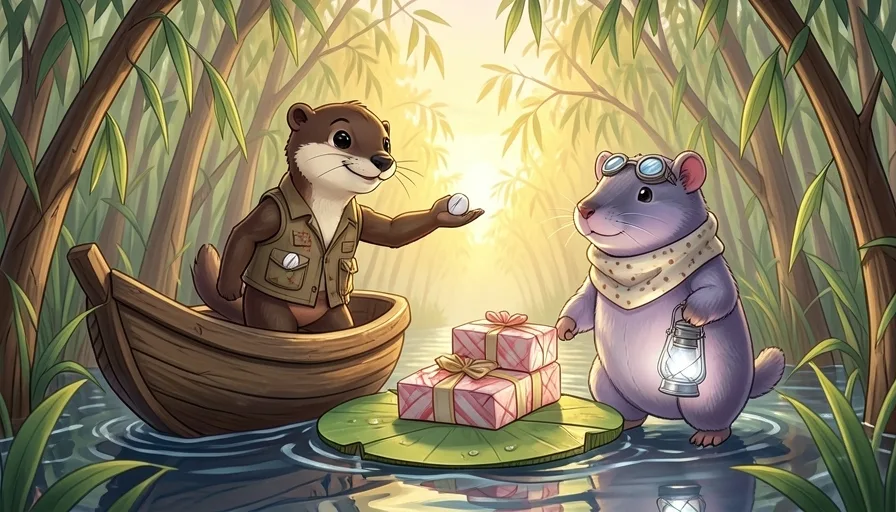
Tully untied the rope from the peppermint stalk and coiled it, slowly, because he had learned a thing or two that morning about slowness. The bundles on Vesper's raft nodded gently as the two crafts drew apart.
'Thank you,' he said, and he meant it more than he had meant most things. He reached into his vest, then hesitated, and drew out Sir Reginald, the stone with the very fine stripe. He held it out across the widening gap of water. 'This is for you. You did not ask. But I would like you to have it.'
Vesper looked at the stone for a long, long moment. Then she took it in one broad toad hand and turned it over, and the white line ran across her palm like a bit of cloud.
'Mm,' she said. 'I have never owned a stone I was given. Only ones I picked up.' She set it carefully on top of a mint bundle, where it caught the light. 'I shall tell it your name.'
'He is Sir Reginald,' said Tully. 'He has a lot of opinions, but they are kind ones.'
'I shall look forward to them,' said Vesper dryly, and she dipped her pole and turned her great flat raft away toward the sunlit end of the channel, humming her grumbling kettle hum.
Tully watched her go, feeling an odd little lightness where the stone had been, as though a pocket he had not known was heavy had been set free.
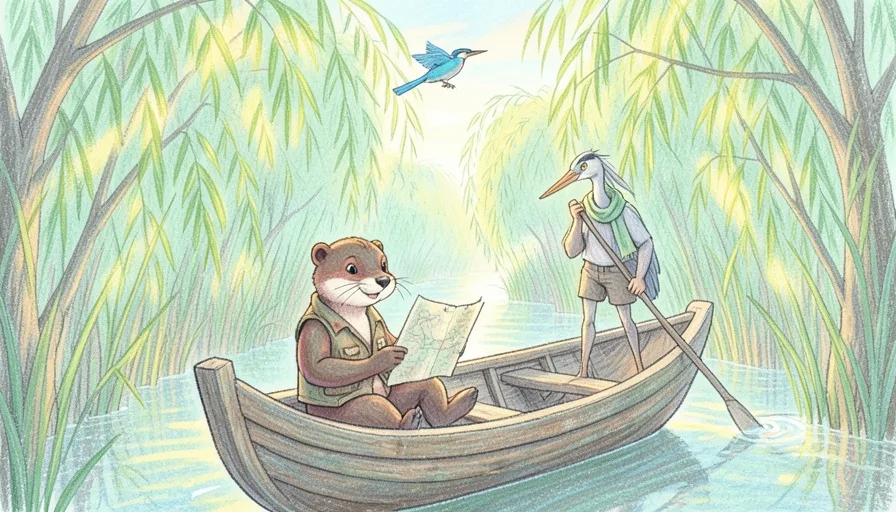
'That was kind,' said Orla, settling at the back of the log and taking up her pole. 'Sir Reginald was one of your favourites.'
'He was,' Tully agreed, 'but there are plenty more shelves at home. And I think he will like toad company. He enjoys a good listener.'
They drifted on in a companionable quiet. The current tugged them along, quick but not wild, and the willows slid by overhead in long green swishes. Somewhere a kingfisher flashed past like a spark of blue. Tully took out the map, spread it on his knee, and ran a paw over the blank patch where the river simply stopped.
'Two days,' he said softly. 'And we are still not there.'
'No,' said Orla. 'But we know three things we did not know this morning. There are lights beyond the last willow. There is a stone that glows. And the water is in a hurry.' She pushed her pole against the bank and the log swung neatly round a bend. 'That is more than a blank patch, Tully.'
He looked at her, and at the quick bright water ahead, and felt something rise in his chest, braver and steadier than the Longest Stripe had ever made him feel.
'Then let us go and meet it,' he said, and the narrow green channel carried them on, laughing, toward the last of the willows.
"A good friend trades a little patience for another's trouble, and finds the way forward waiting there."
The Ring of Stripes
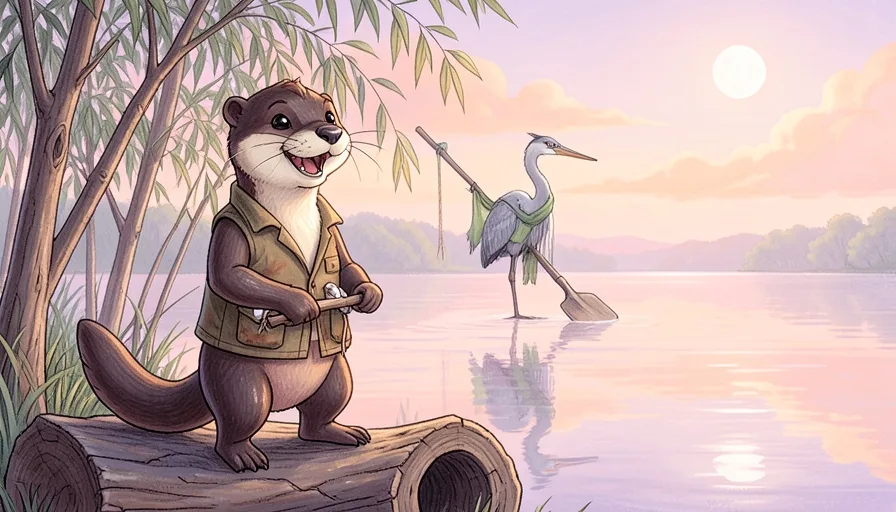
The river did not so much carry them as hand them along. One moment the log was drifting past the last drooping willow, its green fingers trailing across Orla's feathers, and the next the current took hold of them like a friendly giant and gave a great, gentle shove.
'Hold the sides!' cried Tully, though there was nothing to be afraid of. The water was smooth as poured cream, only quick. Willow after willow flicked past, and then the trees simply stopped, as though someone had drawn a curtain aside.
Beyond lay open water, wide and hushed and silver-pink in the evening light. The air smelled of cool stone and wet moss. Tully let his paddle trail and simply stared, for the whole sky had come down into the river, clouds the colour of peach skin and a single pale thread of early moon, doubled in the shining surface.
'Well,' said Orla softly, gliding the pole to a rest. 'That is not on the map.'
'It is not on any map,' Tully whispered, and then, because he could not help himself, he added, 'it is the most map-worthy place I have ever seen.'
They had not drifted far when Orla stiffened. 'Tully. Look. Straight ahead, low on the water.'
It was a ring. A perfect circle of pale stones lifted just above the surface, each one the size of a loaf, each one smooth as a pebble that had spent a thousand years being admired by the river. And every single one had a stripe. Bright white, bold and clean, running through the dark stone like a ribbon of milk.
Tully's paws went to his chest before he knew it. He had never in his life seen so many in one place. He counted twelve, then thirteen, then gave up counting because his heart was beating too fast. 'Oh, Orla,' he breathed. 'Oh, they are beautiful. That one has a stripe like a bolt of lightning, and that one, that one is nearly straight, which is very rare, I will have you know.'
'You may keep one,' said Orla gently. 'I would not stop you.'
He reached out. His paw hovered above the nearest stone, the one with the lightning stripe. It was cool and perfect and seemed to hum faintly against his skin.
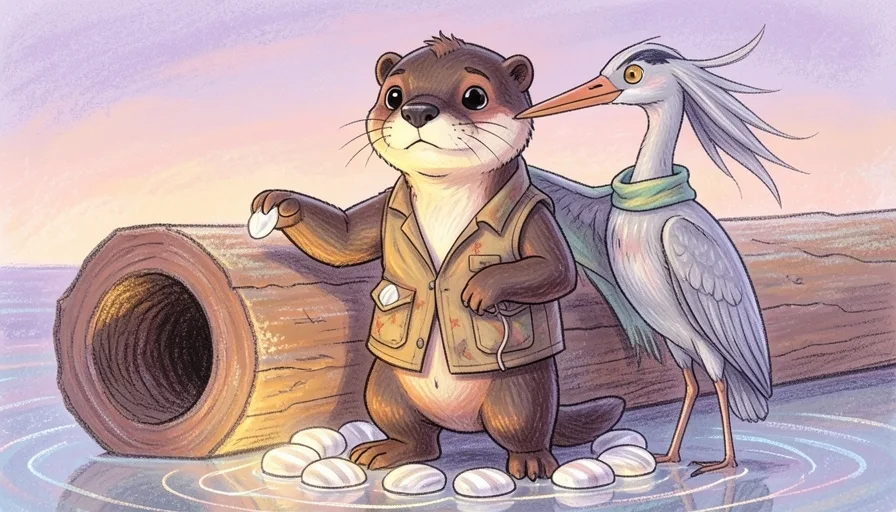
Then Tully stopped.
It was the hum that did it. It was not the hum of a thing waiting to be picked up. It was the hum of a thing that was doing a job. The ring of stones was holding something in, or holding something up, and when he looked closely he could see thin threads of light, no thicker than spider silk, stretching from stone to stone beneath the water.
'Orla,' he said slowly. 'I think these are a fence.'
'Or a lantern-keeper,' she murmured.
Tully drew his paw back. It was the hardest thing he had done since the willow roots, and that had been very hard indeed. His whole collection, the whole round-doored burrow and its crowded shelves, had been built on the notion that a stone with a stripe was a stone that belonged to him. But these stones belonged to the water, and to whatever lay beyond them, and he could feel that as plainly as he could feel the sun on his fur.
'No,' he said, and his voice wobbled a little, and then steadied. 'I shall leave them where they are. The island needs them more than my shelves do.'
Orla did not say a word. She only put a wing across his shoulders for a moment, and the log rocked gently under them both.
They poled slowly through the gap between two of the stones, careful not to scrape a single one. As the log slid through the ring, the water changed. The stripes beneath the surface flickered, once, twice, like a sleepy eye opening, and the current relaxed all around them. It was as if the ring had let out a breath.
'Thank you,' said Tully, to no one in particular, and the nearest stone gave a tiny, bright answering shimmer.
Orla had taken out the old map. She laid it across her knees and tilted her head. 'The moon,' she said. 'Let me count.' She turned her beak toward the pale thread above them and her eyes went distant, the way they did when she was doing sums in the stars. 'It rose in the east at dusk yesterday. It will be full in the evening of tomorrow, not the day after. Not three days, Tully, not even two.'
'How long?' said Tully quietly.
'About a day and a half,' said Orla. 'Perhaps a little less.'
Neither of them spoke for a moment. A small wave patted the side of the log, and another, as though the river itself were offering comfort.
Tully looked at the map, at the blank patch that was no longer quite so blank. Then he looked at the Longest Stripe in his pocket, warm from his paw. A day and a half. It was both much more time than he had feared and not nearly enough for everything he had hoped to do.
'I had a whole plan,' he said, a little foolishly. 'I was going to show you the island and then we would both sleep under the stars, and in the morning we would have breakfast, and it would be perfect, and you would not want to go.' He gave a short, shaky laugh. 'I did not think it through very well.'
'Tully.' Orla folded the map. 'I am going to go. That was never yours to fix.' She said it kindly, in her patient voice, the one that sounded like water over smooth pebbles. 'But I would rather spend a day and a half of adventure with you than three days of waiting at home. Let us not waste another heartbeat being sad about the numbers.'
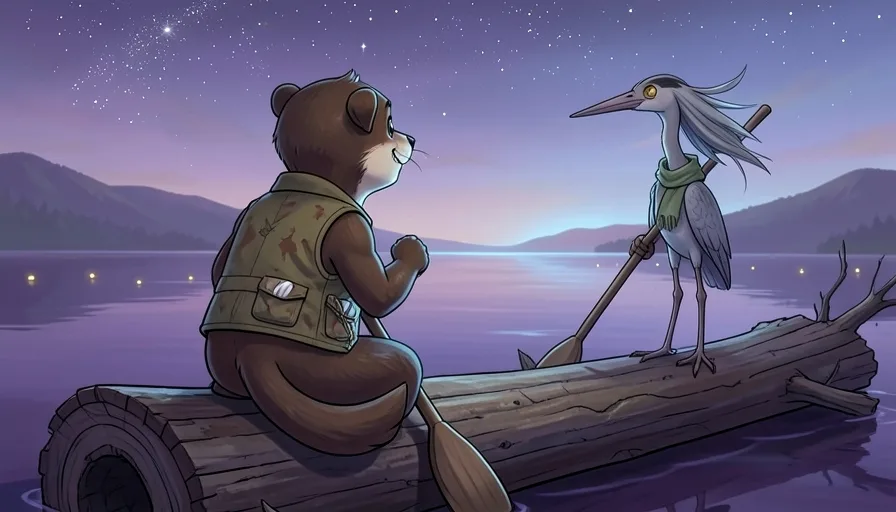
The last of the pink faded from the sky, and the lake turned a deep, soft violet. Stars came out one by one, first a scattering and then a spill, until the water was a second sky and the log seemed to float in the middle of it all.
'There,' said Orla, very softly. 'Do you see?'
Far ahead, low on the horizon where the water met the dark, a tiny flicker of gold winked and vanished. Then another. Then three at once, gathering and drifting like fireflies that had lost their way home. And just beyond them, at the very edge of the dark, there was something else. It did not flicker. It did not drift. It simply glowed, a calm, steady, milky blue, like a stone that had swallowed a piece of the moon.
'Vesper's stone,' Tully breathed. 'The one that glows.'
He gripped his paddle. His heart was thumping, not with worry now, but with the fizzing, uncontainable joy of a very particular kind of otter who has just seen the thing he came for. 'Orla. We are going to get there.'
'Then paddle, Tully,' she said, and he heard her smile in the dark.
"Sometimes the bravest way to love a thing is to leave it where it belongs."